

What is a Blind Flange?
Blind Flanges Explained
Blind flanges are widely used across industrial pipework systems to seal the end of a pipeline, pressure vessel or piping connection. Unlike standard flanges with a central bore, blind flanges are manufactured without an opening, allowing them to completely block flow within a system.
Used across petrochemical, oil and gas, offshore, manufacturing and process engineering sectors, blind flanges help provide safe isolation, maintenance access and pressure containment within demanding industrial environments. Their strong design and pressure resistance make them suitable for both temporary and permanent pipeline closures across a wide range of industrial applications.
What Does a Blind Flange Do?
A blind flange is designed to close the end of a piping system or connection point by creating a secure seal capable of withstanding pressure within the system. It is bolted onto an existing flange using gaskets and fasteners to prevent the movement of liquids, gases or process media.
Blind flanges are commonly used where future expansion, inspection, maintenance or system modifications may be required. They can also be used for testing pressure systems before commissioning or during shutdown procedures within industrial facilities.
Benefits of Blind Flanges
Blind flanges are widely used across industrial pipework systems due to their sealing performance, pressure resistance and ability to safely isolate sections of pipework during operation and maintenance.
Pressure Containment
Blind flanges are designed to provide reliable pressure containment within industrial piping systems operating under demanding conditions.
System Isolation
They allow sections of pipework or equipment to be securely isolated for shutdowns, maintenance procedures and operational safety.
Maintenance Accessibility
Blind flanges help improve maintenance access by allowing systems to be opened, inspected and modified more safely and efficiently.
Future Pipeline Expansion
Pipelines sealed with blind flanges can be expanded or modified more easily in the future without major system redesign.
Strong Sealing Performance
When combined with suitable gaskets and fasteners, blind flanges provide strong sealing performance for industrial applications.
Multiple Material Options
Blind flanges are available in carbon steel, stainless steel, duplex, super duplex and specialist alloy material grades.
Types of Blind Flanges
Blind flanges are available in multiple configurations depending on the pressure requirements, flange facing type and operating conditions of the industrial pipework system. Different blind flange types are used across petrochemical, offshore, oil and gas, manufacturing and process engineering applications where reliable sealing and pressure isolation are essential.
Raised Face Blind Flanges are among the most commonly used types within industrial piping systems. They feature a raised sealing surface designed to improve gasket compression and sealing performance within medium and high-pressure applications.
Ring Type Joint Blind Flanges, often referred to as RTJ blind flanges, are designed for demanding high-pressure and high-temperature environments. These flanges use a machined groove and metal ring gasket arrangement to provide strong sealing performance within critical industrial systems.
Flat Face Blind Flanges are typically used within lower pressure applications or systems where mating flanges also feature flat sealing surfaces. They are commonly specified within certain industrial and utility pipework installations.
High Pressure Blind Flanges are manufactured for demanding applications operating under elevated pressure conditions where strong sealing integrity and reliable pressure containment are critical for operational safety.
Custom Blind Flanges can also be manufactured to meet specific project requirements including bespoke dimensions, specialist materials, unusual pressure ratings and non-standard industrial applications.
Spectacle Blinds are specialised pipeline isolation devices consisting of a solid blind section and an open spacer section connected by a metal bridge. They are commonly used within industrial process systems where pipelines require periodic isolation for maintenance or operational procedures.
Time critical blind flange supply can play an important role during pressure testing, planned shutdown procedures, emergency pipeline isolation or system modifications where sections of pipework need to be sealed quickly and safely. Delays in sourcing the correct flange specification can slow down maintenance operations and increase operational downtime across industrial facilities.
Blind Flange Specifications
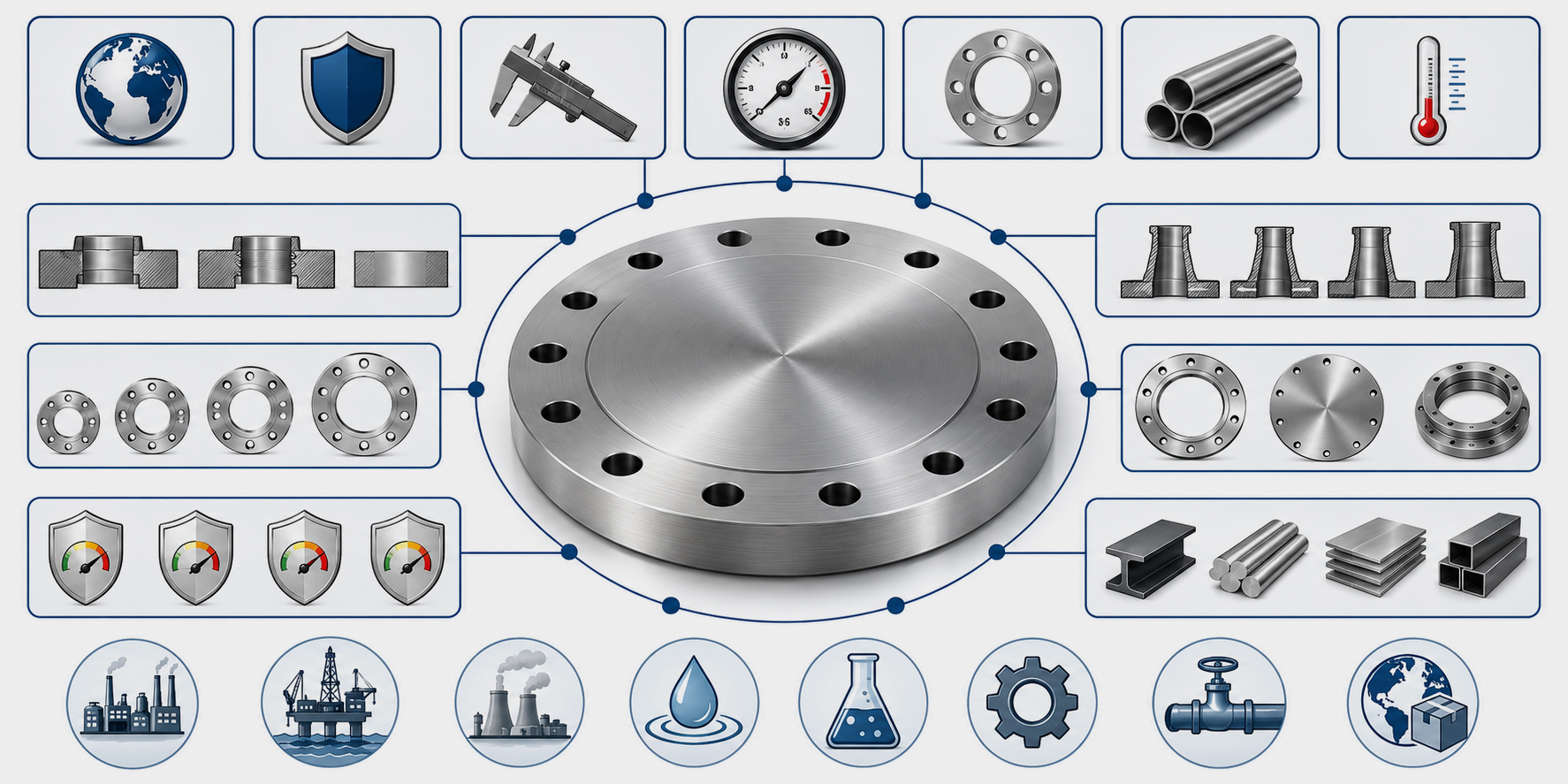
Blind flanges are manufactured to recognised international standards for use within demanding industrial pipework systems across petrochemical, offshore, oil and gas, manufacturing and process engineering sectors. These standards help ensure dimensional accuracy, pressure performance and reliable sealing within high-pressure industrial environments.
Common blind flange specifications include ANSI, ASME, DIN and BS standards depending on the application requirements and regional project specifications. These standards define dimensions, bolt patterns, pressure classes, flange facings and material requirements for industrial flange systems.
Blind flanges are available in multiple pressure ratings and classes to suit varying operating conditions, including low, medium and high-pressure industrial applications. Pressure capability will depend on the flange design, material grade, size and operating temperature of the system.
A wide range of flange facings are available including raised face and RTJ flanges. Raised face blind flanges are commonly used within general industrial applications where improved gasket sealing performance is required, while RTJ flanges are typically specified for more demanding high-pressure and high-temperature systems.
Blind flanges can be supplied in a broad range of sizes and material grades depending on project requirements and operating conditions. Common materials include carbon steel, stainless steel, duplex, super duplex, nickel alloy and other specialist industrial materials.
Material certification and full traceability can also be supplied where required to support project specifications, quality assurance procedures and industrial compliance standards.
Common Blind Flange Materials
Blind flanges are available in multiple material grades to suit demanding industrial environments, pressure conditions and corrosion requirements across industrial pipework systems.
Carbon Steel Blind Flanges
Carbon steel blind flanges are widely used for industrial pipework systems requiring strength, durability and cost-effective performance within demanding applications.
Stainless Steel Blind Flanges
Stainless steel blind flanges provide strong corrosion resistance and are commonly used within chemical, marine and industrial processing environments.
Duplex Blind Flanges
Duplex blind flanges combine high mechanical strength with excellent corrosion resistance for demanding offshore and industrial applications.
Super Duplex Blind Flanges
Super duplex blind flanges are designed for aggressive industrial environments requiring enhanced corrosion resistance and pressure performance.
Nickel Alloy Blind Flanges
Nickel alloy blind flanges offer excellent resistance to heat, chemicals and corrosive process conditions across specialist industrial systems.
High Yield Blind Flanges
High yield blind flanges provide enhanced mechanical performance for demanding high-pressure industrial and structural applications.
Where Blind Flanges Are Used
Blind flanges are widely used across industrial sectors where reliable pressure containment, system isolation and maintenance access are essential within pipework systems. Their ability to safely seal pipeline ends makes them suitable for demanding industrial environments operating under pressure and high temperatures.
Within petrochemical facilities and oil and gas applications, blind flanges are commonly used to isolate sections of pipework during shutdowns, maintenance procedures, pressure testing and future system expansion. Their strong sealing performance makes them suitable for critical industrial systems requiring dependable operation.
Offshore environments regularly utilise blind flanges across pipelines, process systems and industrial infrastructure exposed to challenging marine conditions and demanding operating pressures. High-pressure blind flanges are particularly common within offshore pipework systems requiring enhanced sealing integrity.
Blind flanges are also widely used within power generation and water treatment systems where industrial pipelines may require temporary or permanent closure for maintenance, inspection or operational control procedures.
Within chemical processing and manufacturing sectors, blind flanges help support safe system isolation and maintenance access across industrial process pipework handling aggressive chemicals, fluids and pressurised media.
Across industrial pipework systems generally, blind flanges remain an essential component for maintaining system integrity, supporting operational safety and enabling controlled pipeline isolation across a wide range of industrial applications.
Blind Flange vs Weld Neck Flange
Blind flanges and weld neck flanges are both widely used within industrial piping systems, although each serves a different purpose depending on the application and operating requirements.
Purpose
Blind flanges are designed to seal the end of a pipeline or connection point, while weld neck flanges are used to connect pipe sections within flowing systems.
Flow Capability
Blind flanges completely stop flow within a system, whereas weld neck flanges allow liquids and gases to move through connected pipework.
Pressure Sealing
Both flange types provide strong sealing performance, although blind flanges are specifically designed for pressure isolation and system closure.
Installation
Blind flanges are bolted onto existing flange connections, while weld neck flanges are welded directly onto the pipe to create a strong permanent connection.
Applications
Blind flanges are commonly used for isolation, maintenance and pressure testing, while weld neck flanges are typically used within active process pipework systems.
Maintenance
Blind flanges help provide easier access for future maintenance and shutdown procedures by allowing sections of pipework to be isolated safely.
Why Blind Flanges Are Important for Safety
Blind flanges play an important role in maintaining operational safety, pressure control and maintenance accessibility across industrial piping systems.
Pressure Isolation
Blind flanges allow sections of industrial pipework to be safely isolated while maintaining pressure containment within the system.
Safe Maintenance Access
They help provide safer access for maintenance teams during inspection, repair and modification procedures across industrial facilities.
Shutdown Procedures
Blind flanges are commonly used during planned shutdowns where sections of pipework require temporary or permanent isolation.
Pipeline Testing
Industrial systems often use blind flanges during hydrostatic and pressure testing procedures before commissioning or maintenance work.
System Integrity
Their strong sealing performance helps maintain system integrity within demanding industrial and high-pressure operating environments.
Industrial Compliance
Blind flanges help support operational compliance and safe working procedures across regulated industrial sectors and pipework systems.
Trusted Blind Flange Supply for Industrial Applications
MDS Petrochemical have decades of experience supplying blind flanges and industrial pipework components for demanding applications across multiple sectors. Our team support customers throughout the UK and worldwide with reliable flange solutions tailored to specific project requirements and operating environments.
All blind flanges are supplied to recognised ISO and international industry standards, helping ensure consistent quality, dimensional accuracy and dependable long-term performance within industrial pipework systems. We support projects across petrochemical, offshore, oil and gas, manufacturing, power generation and chemical processing sectors where reliability and pressure performance are critical.
Alongside standard products, MDS Petrochemical can also assist with bespoke flange solutions, specialist material requirements and difficult-to-source industrial components for more complex applications and project specifications. Our extensive industry knowledge and supplier network allow us to support both standard and specialist pipework systems efficiently.
With UK distribution capabilities and worldwide delivery available, we help customers source blind flanges quickly and reliably for projects of all sizes. Technical support is also available throughout the process, from specification guidance and material selection through to product supply and application support.
Sustainability is becoming an increasingly important consideration across industrial pipework and flange supply sectors. High quality blind flanges designed for durability, long service life and reliable sealing performance can help reduce unnecessary waste, minimise replacement frequency and support more efficient long-term industrial operations. Correct material selection and properly specified flange components also help improve system reliability, reduce maintenance requirements and support more sustainable operational practices across petrochemical, offshore, manufacturing and industrial pipework environments.

Blind Flange FAQs
What is a blind flange used for?
A blind flange is used to seal the end of a pipeline, valve or pressure vessel opening within industrial pipework systems. It helps isolate sections of pipework for maintenance, shutdown procedures, pressure testing and future system expansion.
What is the difference between a blind flange and weld neck flange?
A blind flange is designed to block and seal a pipeline connection, while a weld neck flange is used to connect pipe sections and allow flow through the system. Blind flanges do not contain a central bore, whereas weld neck flanges are manufactured for welded pipe connections.
Are blind flanges suitable for high pressure systems?
Yes, blind flanges are widely used within high-pressure industrial systems. High pressure blind flanges and RTJ blind flanges are commonly specified for demanding applications requiring strong sealing performance and reliable pressure containment.
What materials are blind flanges available in?
Blind flanges are available in a wide range of materials including carbon steel, stainless steel, duplex, super duplex, nickel alloy and high yield grades. The most suitable material depends on the pressure, temperature, corrosion risk and operating conditions of the application.
What standards do blind flanges follow?
Blind flanges can be supplied to recognised international standards including ANSI, ASME, DIN and BS specifications. These standards define dimensions, pressure ratings, flange facings, material requirements and performance expectations for industrial flange systems.
Can blind flanges be used temporarily?
Yes, blind flanges are often used temporarily during maintenance procedures, pressure testing, shutdowns and future pipeline expansion projects. They can also be used as permanent sealing solutions within industrial pipework systems.
What industries use blind flanges?
Blind flanges are widely used across petrochemical, oil and gas, offshore, power generation, water treatment, chemical processing, manufacturing and industrial pipework applications requiring safe pressure isolation and sealing performance.
Can blind flanges be supplied worldwide?
Yes, MDS Petrochemical can supply blind flanges across the UK and worldwide. We support standard blind flange requirements, bespoke flange solutions and difficult-to-source industrial components for projects across multiple sectors.